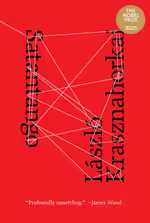
László Krasznahorkai’s Satantango is a bleak, labyrinthine masterpiece that captures the slow-motion collapse of a Hungarian collective farm. The novel is set in a desolate, rain-slicked landscape where the inhabitants are trapped in a state of perpetual decay, waiting for a miracle or a catastrophe. This sense of paralysis and the impending arrival of a “messiah” immediately evokes the shadow of Samuel Beckett. Much like Waiting for Godot, the villagers are suspended in an existential void, though Krasznahorkai twists this trope: in Satantango, the “Godot” figures—the manipulative Irimiás and his sidekick Petrina—actually arrive, only to accelerate the village’s descent into ruin.
This structural playfulness also tips its cap to Italo Calvino, particularly in how the novel treats the “Invisible City” of the villagers’ dreams or in its meta-narrational form as Calvino uses in If on a Winter Night a Traveller. Irimiás’s promise of a new communal life acts as one of Calvino’s symbolic urban fantasies—a perfect, orderly utopia that exists only in the air between a con man’s lips and a victim’s ears. The tension between the “weight” of the mud and the “lightness” of these impossible dreams creates a Calvino-esque dialectic, though Krasznahorkai ultimately lets the weight win, burying the characters under the density of their own history.
One of the most harrowing segments involves the young girl, Estike, and her cat, highlighting the Dantean theme of innocent suffering. Estike, ignored by the adults and tormented by her brother, projects her pain onto her pet, leading to a tragic end (the cat’s poisoning and her death). This serves as the moral pivot; while the adults plot, the death of innocence occurs in the shadows.
Irimiás understands that for these people, even a lie is better than the silence of the rain. His manipulation is the novel’s cruelest irony—he offers a map out of the Dantean circle, only to lead them into a deeper level of entrapment. This “map” is a Borgesian motif; the villagers mistake the representation for reality, following a guide who is as lost as they are, but far more dangerous. He is no Virgil.
The prose style features a “maximalist” intensity where a simple act—like the Doctor observing the village—becomes a philosophical meditation. The sentences do not breathe; they accumulate. We the readers are walled in by uncompromising page-filled ink; it is unrelenting, but for the breaths we can take between the 12 chapters in two parts.
This meticulous cataloging of decay recalls Calvino’s precision in Mr. Palomar, where the observer’s attempt to quantify the world only reveals its infinite, terrifying complexity.
The ending provides a meta-fictional twist that brings the Beckettian circularity and Borgesian infinity to a logical extreme. The Doctor begins to write down the events of the story he has just lived, starting with the very first line of the novel: “One morning in late October, not long before the first raindrops fell…” This loop suggests the “tango” is eternal. The characters are trapped not just in a village, but within the text itself—a Calvino-like recursive machine that ensures their failures are repeated for as long as the book exists. It is a synthesis of Beckett’s comedy, Dante’s hell, McCarthy’s violence.