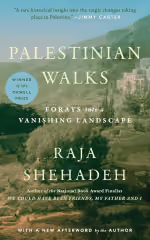
Raja Shehadeh’s Palestinian Walks is a series of reflective essays about moving through the landscapes of the West Bank and Gaza region, where walking becomes both a practical act and a way of thinking. Rather than writing conventional travel reportage, Shehadeh treats the route itself as a narrative device—using roads, paths, hills, fields, and ruins to explore how everyday geography is shaped by politics, memory, and loss. The book’s atmosphere is quiet and observant, with the ordinary details of terrain opening into larger questions about what it means to belong to a place under constraint.
As Shehadeh walks, he repeatedly returns to the tension between visible land and contested meaning. Checkpoints, permits, closures, and shifting boundaries reorganize movement and make some routes feel unreachable even when they are physically close. This produces a particular kind of historical awareness: we sense how the land is not only a backdrop but an active participant in Palestinian life, continually marked by control, fragmentation, and the aftereffects of displacement. His descriptions emphasize that what people can do—where they can go, how far they can travel—directly influences how they relate to culture, family history, and the future.
Memory and literature play an important role in the book’s pacing and emotional register. Shehadeh often connects what he sees on the ground to older stories—biblical places, village histories, names carried through generations, and earlier layers of collective experience. This layering is not purely nostalgic; it functions as a counter-archive to erasure. By linking present-day walks to remembered or imagined earlier realities, he shows how Palestinians preserve continuity through language, storytelling, and attention, even as the physical world is altered.
The essays also explore the personal dimension of walking: the body’s effort, the weather, the changing light, and the small decisions that shape each day’s journey. In Shehadeh’s account, the act of moving slowly allows for concentration and companionship with the landscape, offering moments of beauty even amid restriction. At the same time, those moments are never detached from uncertainty—walking can be restorative, but it also exposes vulnerability and the fragility of freedom.