Tony Smith’s Monumental Vision for our Front Yard
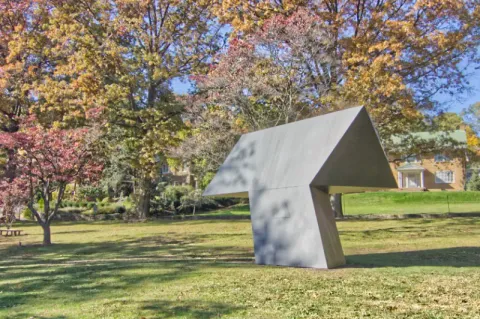
Tony Smith, a towering figure in American sculpture, indelibly shaped the landscape of modern art with monumental, intellectually rigorous works that fuse architectural thinking with minimalist clarity. Born and raised in South Orange, New Jersey, Smith drew early nourishment from the town’s streets and surrounding topography, later channeling those impressions into an art of scale, geometry, and experiential space. His architectural training—first at the New Bauhaus in Chicago under László Moholy-Nagy and subsequently in the orbit of Frank Lloyd Wright—cultivated a fluency with structure, material, and proportion that became the backbone of his sculptural practice.
Smith’s public emergence came relatively late, yet his impact was immediate and far-reaching. He is best known for austere, geometric sculptures fabricated in steel and frequently finished in matte black, where surface restraint intensifies spatial drama. Works such as “Die” (1962) and “Gracehoper” (1962) distill form into elemental modules, staging a dialogue between mass and void, object and environment. Rather than functioning as static aesthetic artifacts, these pieces operate like architectural interventions, replotting a site’s circulation and recasting a viewer’s sense of distance, horizon, and bodily scale. Their starkness is not reductive; it is catalytic, activating perception and inviting sustained, ambulatory looking.
The philosophical ambition of Smith’s sculptures extends beyond formal elegance. He gravitated to archetypal geometries for their psychological resonance, probing how primal shapes might summon awe, contemplation, or a subtle unease. Confronted with his large-scale works, viewers often experience a compound of intimacy and estrangement, as if entering a grammar of space that is at once legible and uncanny. In this way, Smith’s art interrogates humanity’s position within the wider order of things—cosmic, architectural, and social—without resorting to narrative or ornament.
A defining case of Smith’s ideas returning home is the installation of his 1961 sculpture “Tau” in South Orange, New Jersey. Sited within the community that formed his earliest sensibilities, “Tau” brings the artist’s vocabulary of modular planes and right-angled junctures into direct conversation with familiar streetscapes and pedestrian flows. The work’s cruciform, beam-like configuration establishes lucid axes that frame movement and sightlines, functioning almost like a compact gateway or marker within the town fabric. Its matte surface absorbs light, muting glare and sharpening edges so that volumes read cleanly against seasonal shifts—snow, leaf, and brick—while its human-adjacent scale invites close passage, encouraging viewers to walk around, under, and along its spans.
“Tau” also exemplifies Smith’s commitment to the calibrated relationship between sculpture and site. In South Orange, the work does not dominate so much as it reorients, creating a threshold that subtly reorganizes the surrounding space. As one approaches, the piece toggles between planar abstraction and skeletal architecture; as one departs, it punctuates memory with a durable silhouette. The installation underscores Smith’s belief that sculpture could be a civic and contemplative instrument—neither commemorative in the traditional sense nor purely decorative, but a spatial proposition that heightens awareness of the built and natural environment.
Across his career, Smith bridged architecture, painting, and sculpture to forge a practice that remains influential for artists, architects, and designers alike. The enduring power of his work lies in its capacity to make space thinkable and felt: to compress vast ideas into rigorous forms and to let those forms unfold slowly as viewers move through and around them. From the canonical clarity of “Die” to the site-responsive poise of “Tau,” Tony Smith’s legacy endures as a testament to how minimal means can generate maximal resonance—intellectually, physically, and civically.
Related
- Artist Anthony Triano — 25 May '26
- Perfect Days — 18 Apr '24
- Time is Joy (“El tiempo es alegría”) — 8 Mar '26