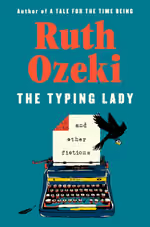
“Feelings” is a short story by author Ruth Ozeki, from her most recent collection of stories, The Typing Lady. What begins as a simple tale about two young girls, Meghan and Kai, and a homework assignment to apply compassion somehow to someone over the Christmas holidays and write about it, broadens in scope enough to shake a friendship and, perhaps in Kai’s mind, her emotional blindness.
Parental relationships come into play, economic status, as well as the changing target of their project, which they begin as a team: at first a homeless man asking for money on a street corner (doesn’t go as planned) to Patty Potts, a friendless classmate, who wears dishevelled clothing and has other issues with her appearance and mannerisms and, my god, only eats egg sandwiches, which smell like farts.
The plan Meghan and Kai hatch is to write a letter to Patty to say that, despite these flaws, they’d like to be friends, but it becomes complex: who should sign the letter? Send it anonymously? Send it in invisible ink?
Out of frustration, Kai types one up at her father’s office on a 1964 IBM Model C Executive, but never sends it. The narrator would later reference writing poems, plays, and dramas on the same typewriter, so we can surmise that Kai is the narrator.
Meghan’s and Kai’s feelings aren’t supposed to solve this problem; they need to find a way to empathize with Patti, and that requires imagination. Feelings in this story feel (hah) internal for the writer. How one feels is a subjective, inward-looking activity. Empathy requires putting oneself into another’s life, an act of imagination that may or may not succeed. But the young Meghan and Kai never really attempt to do that with Patty. Nor does the narrator for Meghan.
Yet the others in Meghan’s and Kai’s lives—from Meghan’s siblings to the homeless man to their teacher to their parents—are similarly caught in a communications void. Everyone misses the mark on this compassion “homework”, but the future Kai (perhaps if we identify her momentarily with Ozeki?), who has learned from it and wrote this story so that we may learn.
The story concludes:
She [Kai] remembers how confused and hurt she was when that bond broke. At the time, she had no idea what was happening in her friend’s family, no capacity to imagine what her friend was suffering. Her failure, she later realized, wasn’t a failure of compassion so much as a failure of imagination, and this thought haunts her. Even now, whenever she types a story, she worries. She worries about this every time.
There are ten other stories in this collection, and I can’t wait to get to them and learn from this Zen writer. (The author is a Zen priest in addition to her writing award-winning novels and short stories).