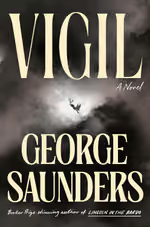
This is the finest climate change novel I’ve read, but it’s way more than that. It’s a novel about empathy. About coping in a deterministic world, where capitalism has consumed itself, left billions in hell while enriching a few.
Vigil centers on Jill “Doll” Blaine, a woman who died tragically in her early twenties during the 1970s and now serves as an ethereal death doula. Operating in a liminal, afterlife space reminiscent of Saunders’s Booker Prize-winning Lincoln in the Bardo, Jill’s spiritual assignment is to plummet to Earth and provide profound comfort to souls in their final, earthly hours. Having successfully ushered 343 souls into the next realm by absorbing their pain and easing their transition, Jill’s routine is completely upended by her latest assignment: K. J. Boone, an exceptionally powerful, octogenarian Texas oil tycoon.
Jill is able to whisk anywhere and to anyone’s orb of thoughts any time, absorbing their world views and gaining empathy even for the lowest mammon grubbing CEO, whose deathbed is the primary scene of the novel.
Unlike Jill’s past charges, Boone is completely belligerent, combative, and entirely unrepentant regarding his legacy. He firmly believes he lived a grand, successful life, refusing to acknowledge his massive corporate greed or his complicity in funding climate change denialism that accelerated global ecological devastation. As Boone lies unconscious on his deathbed, his room becomes an crowded, chaotic staging ground where the boundary between the living and the dead collapses. A surreal menagerie of entities descends upon the mansion demanding a cosmic reckoning—including a swarm of birds, a spectral black calf, victims of drought-ravaged villages, and a persistent French ghost intent on forcing Boone to atone for his environmental sins.
Jill is so horrified by entering Mr Bhuti’s thought sphere, seeing the wreckage and death that climate change did to his village that she had to cleanse her mind by dashing in and out of dozens of wedding guests to weaken the images that were embedding in her psyche.
Vigil is no doubt a variation of Dickens’s A Christmas Carol, with Jill trapped in the middle of a fierce spiritual tug-of-war over Boone’s defiant consciousness. While the vengeful French spirit and corporate cronies from Boone’s past arrive with chilling agendas for his post-morintal future, Jill uses her ability to merge with the living and the dead to read their minds, unearthing childhood memories and the desperate, complicated love offered by Boone’s family. The text explores a complex moral tension: the narrative dares the reader to consider whether compassion and dignity should be extended to an architect of global catastrophe, even as he stubbornly clings to his ego and refuses to express a single shred of deathbed remorse.
Simultaneously, the intense confrontation with Boone’s unyielding psyche forces Jill to confront her own long-repressed earthly existence. For nearly fifty years, Jill has used her cosmic duty to avoid processing the grief of her own untimely death, which occurred via a car bombing meant for her police-officer husband in Indiana. As she tries to guide her stubborn charge toward a surrender of ego, she falls into deep, episodes of memory, reliving details of her past and wrestling with the realization that she, too, has been unable to fully let go of her mortal attachments. She sunders herself into Jill and not-Jill for some time to allow the Jill to reconcile her life while the not-Jill death doula continues to perform her tasks.
Saunders introduces a deeply humanist yet deterministic undercurrent to the climax, questioning whether human behavior is merely an inevitable byproduct of nature, nurture, and circumstance, thereby rendering deathbed repentance entirely illusory. When Boone’s past misdeeds finally catch up to him in his final seconds, the novel leaves readers to grapple with the heavy existential weight of memory, the complicated necessity of letting go, and the radical, almost frustrating demand for grace in a deeply fractured world.
Free will sounds nice, but no one is free from the circumstances of their post code, parental income, and upbringing. Not to mention location on the planet they were born on.