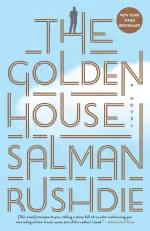
In the humid, over-ripened air of a post-Obama Manhattan, where the sunlight hits the brownstones of Greenwich Village with a cloying, amber insistence, we find the “Gardens”—a private enclave of old-world quietude suddenly invaded by the operatic. Nero Golden, a man of heavy, sepia-toned secrets and a girth that suggests a kingdom lost or perhaps merely packed into high-end luggage, arrives with his three sons like refugees from a myth that has lost its footing. They have shed their Indian surnames for the Roman weight of “Golden,” an American reinvention that smells faintly of mothballs and gunpowder.
Nero is the patriarch in his twilight, a Lear in a silk dressing gown, presiding over a trio of sons who embody the fractured anxieties of our flickering century. There is Petya, the eldest, whose agoraphobia and high-functioning autism make the world’s sensory rub feel like sandpaper against an exposed nerve; Apu, the artist, whose canvases seek to capture the numinous ghosts of a Mumbai they left behind; and D, the youngest, who navigates the soft, unfinished clay of gender identity with a tentative grace that the world—increasingly coarse and neon-lit—seems eager to bruise.
Observing them from the sun-dappled shadows is René, a young filmmaker with a voyeur’s squint and an artist’s hunger. He treats the Goldens as a specimen, a cinematic “find,” peering through his lens at the family’s domestic friction as if he might capture the very soul of the immigrant experience in a well-composed mid-shot. But the lens is a dangerous filter; René finds himself pulled into the gravitational well of their tragedy, his own life becoming a messy, unscripted B-story to their grand, doomed narrative.
Into this fragile ecosystem steps Vasilisa, a Russian gymnast with a heart of cold, metallic ambition. She marries the aging Nero, her youth a sharp, gleaming blade held against the mahogany throat of the family’s legacy. She is the usurper in the garden, a creature of pure, tactical will who understands, far better than the brooding Golden sons, that the American dream is no longer a pastoral poem but a ruthless acquisition.
Beneath the domestic squabbles and the high-literary allusions, there is the distant, rhythmic thrum of a world going mad. Rushdie’s America—filtered here through prose that seeks the tactile detail of a shingled roof or the specific texture of a New York rain—is being haunted by “The Joker.” This pale, green-haired insurgent of the airwaves signals a coarsening of the national spirit, a shift from the dignified, if flawed, order of the past to a grotesque, cartoonish present where truth is merely a matter of who shouts loudest. Who on earth could he have been thinking of?
The past, of course, is the ultimate aggressor. The secrets of Mumbai—the 1993 bombings, the smell of cordite and betrayal—refuse to stay buried beneath the cobblestones of the Village. The Golden house is not a fortress, but a sieve. Violence, long-gestating and inevitable, eventually arrives to claim its debt, turning the operatic into the incinerated.