del Toro's Frankenstein
In a world of accelerating AI technologies and the very expensive quest for AGI (artificial generative intelligence), the story of Frankenstein is more relevant than ever.
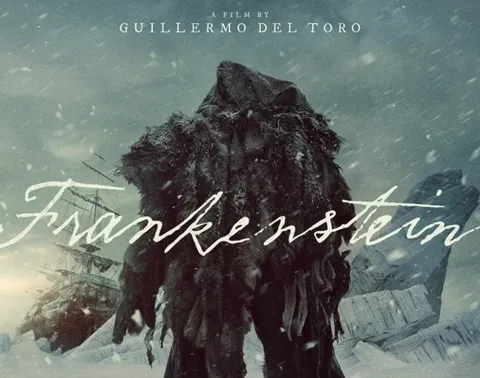
del Toro breaks the movie into three parts:
- Prelude
- Victor’s Story
- The Creature’s Story
Prelude
In the prelude, we witness what is, in effect, the near culmination of the story, somewhere in the Arctic Circle, where a Royal Danish Navy ship is caught in the ice as it attempts to reach the North Pole. They hear screams and see a fire, so they send a contingent of men to investigate and find a badly injured man, who turns out to be Dr Victor Frankenstein. They bring him back to the ship, and while almost aboard, they hear the angry yells from the creature, who is tracking them. They fire at him, and to their wonderment, the arms fail to kill him.
Finally, they manage to get Victor aboard, and the story-within-a-story motif begins. Victor tells his version of events that have brought him up to the present.
Victor’s Story
Victor’s story is the tale of a young man, inspired by the tragic death of his mother giving birth to his younger brother, to become a surgeon and find a way to make death avoidable (bring immortality to humankind). This soon becomes an obsession, and with funds secured from a wealthy benefactor dying of syphilis, who hopes to take advantage of the discovery, Victor obtains the equipment and gloomy lab (a castle with a tower) required to perform his science.
Victor needs cadavers to gather body parts, so he visits the gory aftermath of a battlefield and picks out his specimens. He harvests a head from this one, arms from that, strong legs from another, etc.
As soon as the stitched-together creature is complete and the remnants of the bodies disposed, a storm miraculously appears—the lightning required to bring life. However, the experiment has failed. Or has it? He retires to his private quarters.
In the middle of that night, he hears a noise in the depths of the basement. He rushes down and comes face to face with his creation and immediately chains it (him) to an iron rod. Victor is pleased and says. “My name is Victor,” to the creature; “what is your name”? No reply, just a low growl. But eventually, “Vic-tor” issues from the creature’s mouth.
Eventually, Victor gets fed up with this one-word thing he created, and he starts administering harsh beatings to induce additional words from his creation. Not really a winning strategy. The creature’s wounds heal rapidly, but he has become morose about his lonely condition. Victor’s sister Elizabeth and her fiancé, William, come to visit one day out of the blue. Victor invites them in and quickly tries to usher them up a floor for their visit, but while Elizabeth’s husband bounds up the stairs, following Victor, Elizabeth hears the creature’s moans and descends to the dungeon.
Elizabeth approaches the creature without fear and asks him if he was wounded in battle. No response. Elizabeth then joins her husband and Victor and enquires about the man in the dungeon and why he is in chains. Victor finally admits his great success in creating life.
After the two depart, Victor is determined to kill his creation. He pours gasoline all over the dungeon floor and makes one final demand, “Say a word other than my name!” and walks away, strikes a match, holding it. “Elizabeth,” the creature says, which angers Victor because of his jealousy that she could have him speak. He tosses the match, and the entire tower goes up in flames, tipping over. Elizabeth and her husband look back in horror while Victor catches up to them to hitch a ride.
The Creature’s Story
The creature’s (his) story tracks with my recollection of Mary Shelley’s novel with a few bits of poetic license. When I say poetic, that is quite literal.
In a scene where the blind man teaches the creature one of the lessons comes from a book of Percy Bysshe Shelley’s poetry (published the same year as the novel, 1818), only the poem read by the creature in the movie is “Ozymandius” (1818) and not the one from the novel, “Mutability” (1818). [1]
To return to the movie, during the castle’s demise, the creature manages to escape and, after being hunted and shot by two men, finds a mill in which to pass a miserable winter. In the spring, the mill’s family returns with their flock of sheep to take up residence again. The creature hides and furtively listens to them, slowly learning (or re-learning) language. When he sees them working, gathering tinder for fires, he spends time at night gathering twice as much for them. He seeks to be of use.
One day, wolves attack and begin killing the family’s flock of sheep. The men go for their guns as the creature tries to look on and is upset when the guns are shot, and the wolves begin dying. The family decides to go out and hunt the wolf pack down and sell the lamb meat from the killed sheep in town, so the remainder of the flock is safe.
When they leave, the old, blind man summons the creature out of hiding, as he had heard him all along. He teaches him to read from books—the Bible, Paradise Lost, and Shelley’s poetry, as mentioned above—and they develop a friendship.
The creature wants to know about his own identity, and the old man tells him to return to the castle for any clues, which he does. It takes the creature little time to learn he is not a man, but a collection of pieces of dead men. He is horrified.
The creature also finds a letter bearing Victor’s address; he is determined to hunt him down and demand retribution, an ultimatum: create for him a companion.
On the day of William and Elizabeth’s wedding, the creature arrives and finds Victor alone, and makes his request. Victor’s response: “Death begetting death begetting death.” In other words, no.
The creature flies into a rage and throws Victor across the room with such force that the wedding guests downstairs can hear it. Elizabeth comes to the room and, upon seeing the creature alive, walks up to him and puts her hands gently on his face. Victor picks up a pistol and yells at Elizabeth to move away. She screams no in defiance and moves in front of the creature. In the same instance, Victor has fired the pistol, and Elizabeth receives the bullet and falls to the floor.
The creature picks Elizabeth up and carries her to a nearby cave, where they share a tender moment before she dies.
Victor trails after the creature with a rifle. He follows him north of the Arctic Circle, where, after attempting another pathetic volley of rifle shots to the creature does nothing, the creature drags him out of the tent for a bruising, during which time Victor reaches into his bag for a stick of dynamite. The creature holds the stick of dynamite, hoping it will end his interminable, lamentable life, tells Victor to light it and run, but if it doesn’t kill him, he will pursue him further.
Naturally, it doesn’t kill him, so the creature tracks Victor back to the iced-in warship, and we come around to the start of the movie and pick up for the final scenes, where, as Victor lies dying, he and the creature make a final peace. Victor, addressing the creature as ‘son’, asks for forgiveness, and the creature, gently kissing Victor’s forehead, grants it.
Victor’s last request of his creation is, if you are doomed to live, then live.
Mary Shelley wrote this during the midst of the Industrial Revolution and new scientific discoveries. The message is to be responsible for inventions. Do not create and abandon the new. Create and regulate it, bear responsibility as a parent would for a misbehaving child who knows no better. Frankenstein, the book will likely always be better than any film adaptation, but del Toro’s is the best I’ve seen.
Shelley, Mary. Frankenstein. Chapt. 10. ↩︎