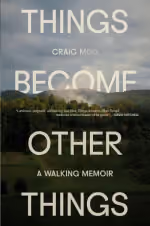
This is a great book to own in its physical form, as numerous photos are interspersed throughout the essays on the natural beauty of Japan’s Kii Peninsula and its disappearing villages and life.
A map plots Mod’s route along the eastern coastline, through once-thriving villages, many now reduced in many areas to a few kissas (akin to diners, though much smaller and offering a far sparser menu than their counterparts in, for example, New Jersey), some ryokans here and there, and industry mainly focused on fishing and lumber.
Bashō, the inventor of the Haiku, travelled and documented this route using poetry rather than photography to portray its deeply felt beauty and sadness in his essay, The Records of a Weather-exposed Skeleton.
The walk and the environs are the stage settings for the people Mod encounters, who share this forgotten land south of Nara. The keepers of inns and kissas, the fellow travelers he rarely bumps into, the heavy-set western priest Seamus, who miraculously shows up at the outset of a heavy downpour to give him a lift. No one seems to be younger than 60, and yet occasionally he sees children at play. He frequently reaches into “The Book of John” when he arrives at important historical landmarks. Twenty years Mod’s senior, John is the person who introduced him to hiking many years ago, a practice John has maintained for decades. He and Mod are fluent Japanese speakers, but Mod learned much from John in different ways of speaking with people, and John often provides deep insight into the history of various pilgrim paths, shrines, historical figures, and more. Throughout the journey, John tracks Mod’s progress by GPS, serving as his guidebook.
However, the real arc of this story/trek is this: The book is a personal love letter to a childhood friend, who was murdered at the age of seventeen. Hiking has been how Mod comes to terms with his friend’s violent end. A certain political or societal undercurrent is always in the background, as well, comparing America’s culture of violence and individualism with the peaceful nature of Japanese culture he has lived in for the past two decades. Sometimes, it is quite overt.
Today, I feel nothing like an “expat,” that word of extreme privilege applied to Westerners moving east, a word charged with connotations of asymmetric power, of non-permanence, of elevation above and immunity from local laws and customs, of your “home” being better, a place to which you’d obviously return. …How can you say a country “loves” you without providing healthcare? When the schools are criminally underfunded? It took me a while to see this clearly, though. But the more I looked, the more my norms were reconfigured, the clearer it became: Here was a place where people were taken care of by the greater whole.