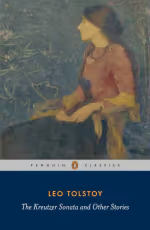
Leo Tolstoy’s The Kreutzer Sonata is not only a profound exploration of marriage, jealousy, and the destructive power of unchecked desire, but also a deeply personal work reflecting the author’s own philosophical crisis. Framed as a confession overheard on a long train journey, the novella centers on Pozdnyshev, a man who recounts the tragic unraveling of his marriage and his eventual crime. His narrative serves as a fierce critique of societal norms surrounding sexuality and marriage—themes that mirrored Tolstoy’s own evolving spiritual convictions.
Pozdnyshev begins by describing his youth, shaped by the decadent hedonism of the Russian aristocracy. He indulged in promiscuity and viewed women primarily as objects of pleasure, a mindset he blames on a corrupting society. This perspective directly reflects Tolstoy’s own youthful indiscretions prior to his moral awakening; Pozdnyshev’s self-loathing sets the stage for his ultimate disillusionment with marital life.
Though Pozdnyshev’s marriage begins with a veneer of happiness, it rapidly devolves into a cycle of mutual resentment and emotional warfare. This dynamic echoes Tolstoy’s volatile union with Sophia (Sonya) Behrs. Though initially passionate, their marriage became severely strained by Tolstoy’s radical asceticism, his public renunciation of property, and Sophia’s pragmatic demands for their large family.
As the story progresses, Pozdnyshev grows obsessively jealous, suspecting his wife of infidelity without any concrete proof. His psychological torment reflects Tolstoy’s own lifelong struggles with possessiveness and paranoia, documented extensively in his diaries.
The story’s turning point occurs when Pozdnyshev’s wife begins playing music with a visiting violinist, Trukhashevsky. When the duo performs Beethoven’s Kreutzer Sonata, Pozdnyshev interprets the passionate, volatile piece as an incandescent expression of physical desire. The music becomes the ultimate symbol of an emotional betrayal he is convinced is taking place.
This obsession culminates in a brutal climax: returning home unexpectedly, Pozdnyshev finds the pair together and stabs his wife to death in a fit of rage. While Tolstoy never resorted to physical violence, Pozdnyshev’s extreme actions serve as an avatar for Tolstoy’s own hostility toward carnal relations.
Following the murder, Pozdnyshev spends eleven months in prison before being acquitted by a jury that views him as a wronged husband defending his honor. Yet despite his legal exoneration, he is utterly ruined—haunted by guilt and consumed by the realization that his jealousy was fueled by an ideology that treats human beings as possessions.
Throughout his overwrought monologue, Pozdnyshev articulates Tolstoy’s late-life philosophy: that physical desire is an irredeemable force, that conventional marriage is merely legal prostitution, and that absolute celibacy is the only path to moral purity.
Literary scholar George Steiner points to several key philosophical influences on the novella beyond Beethoven’s music: Jean-Jacques Rousseau’s Confessions (for its unsparing exposure of guilt), Fyodor Dostoevsky’s Notes from Underground (for its claustrophobic psychological turmoil), and Arthur Schopenhauer’s philosophy of renouncing desire—specifically his assertion in On the Basis of Morality (1840) that true compassion is the sole non-egoistic, moral motive in human existence.