Light-vented bulbul
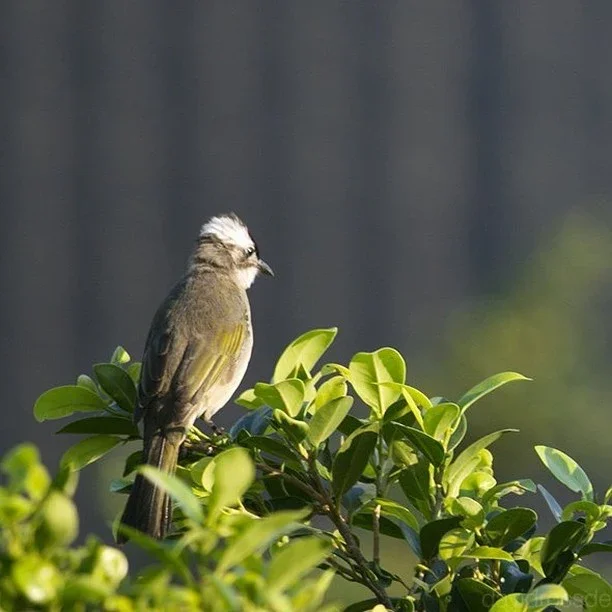
The light-vented bulbul (Pycnonotus sinensis), also known as the Chinese bulbul or white-vented bulbul, is a common and noisy songbird found in East and Southeast Asia. It is known for its distinctive black-and-white head pattern and bright, variable song.
-
Key Characteristics Appearance: The adult light-vented bulbul is approximately 19 cm (7.5 inches) long. It has a greyish-brown back with olive-fringed wings and tail, whitish underparts with a pale brown breastband, and a prominent black and white head pattern. Its most notable feature is a large white patch covering the nape and sides of its black head.
-
Habitat and Distribution: Native to central and southern China, Hong Kong, northern Vietnam, southern Japan, and Taiwan, this adaptable bird thrives in a variety of open environments, including lightly wooded areas, gardens, orchards, scrubland, and urban parks. Its ability to live near human settlements has helped its range expand, and it is listed as a species of Least Concern.
-
Diet: Like other bulbuls, it is primarily a frugivore, feeding on a variety of berries, small figs, soft fruits, and nectar. It also consumes insects, which it sometimes catches in the air. The bulbul plays a crucial role in the ecosystem as a seed disperser, aiding plant propagation.
-
Behavior: It is a social bird often seen in pairs or small flocks. It produces a cheerful, ringing song often transcribed as “wee-wee-der-wee” or “cha-ko-lee”.
-
Breeding: The breeding season typically runs from April to June. Females build a firm, cup-shaped nest in a bush or hedge, usually between 1-3 meters above the ground, using grass, leaves, and twigs. They typically lay a clutch of 3-4 eggs, and both parents care for the young.
Photographed in Hong Kong using a Canon 50D with 70-200mm lens. Species data from Google Gemini.