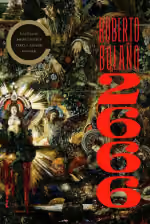
Roberto Bolaño’s colossal, masterwork 2666 was published posthumously in 2004, standing as a dark, encyclopedic monument to twentieth-century violence, literary obsession, and systemic evil. Though broken into five distinct novellas, the book’s gravity is anchored by Santa Teresa—a fictionalized Ciudad Juárez where a relentless, terrifying wave of unsolved femicides forms a black hole at the center of the narrative.
I. The part about the critics
The novel opens with an academic quartet of international literary scholars—Jean-Claude Pelletier (France), Piero Morini (Italy), Manuel Espinoza (Spain), and Liz Norton (Britain)—who are bound together by an obsessive, career-defining passion for the work of Benno von Archimboldi, an elusive, Pynchon-esque German writer who has spent decades hiding from public view.
Their academic rivalry gradually morphs into a shifting, complex sexual and intellectual square. When rumors surface that Archimboldi has been spotted in the sprawling, violent Mexican border city of Santa Teresa, the critics abandon their European libraries and embark on a quixotic pilgrimage to find him—unwittingly stepping onto the doorstep of a much darker mystery.
II. The part about Amalfitano
The second section pivots to Oscar Amalfitano, a melancholic Chilean philosophy professor who has relocated to Santa Teresa to escape his past and secure a university post. As he lives alone with his university-student daughter, Rosa, Amalfitano begins a slow, agonizing descent into psychological isolation and terror.
He becomes intensely paranoid that Rosa is vulnerable to the city’s predatory undercurrents. In one of the novel’s most striking, surreal images, Amalfitano hangs a geometry textbook by its spine from a wire fence in his backyard, leaving it to flutter in the wind so the desert elements can “teach” mathematics to the elements—a manifestation of his growing sense of helplessness as the region’s epidemic of violence begins to bleed into his own life.
III. The part about Fate
The third part introduces Quincy Williams (writing under the pen name Oscar Fate), an African American journalist for a black-interest tabloid in New York. Sent to Santa Teresa to cover a heavyweight boxing match, Fate finds his superficial sports assignment instantly upended by the grim reality of the border.
Through Fate’s eyes, the novel exposes the stark disconnect between international media indifference and the human cost of the local femicides. He crosses paths with Amalfitano’s daughter, Rosa, and begins to grasp the corrupt machinery of the local police, politicians, and drug cartels. Fate’s journey is an awakening to the systemic rot of Santa Teresa, where human life is treated as utterly disposable.
IV. The part about the crimes
The fourth part is the emotional and structural core of 2666—a harrowing, meticulously cataloged ledger of the real-life-inspired murders in Santa Teresa. Over hundreds of pages, Bolaño documents the discovery of murdered, mutilated women found dumped in empty lots, irrigation canals, and desert brush.
Written in a chilling, clinical, police-report style that purposefully risks numbing the reader, this section details case after case with brutal repetition. It captures not just the violence itself, but the suffocating bureaucracy, forensic incompetence, institutional apathy, and casual misogyny that allow a multi-year slaughter to happen in plain sight with almost zero accountability.
V. The part about Archimboldi
The final section resolves the mystery of the elusive author, tracing the life of Hans Reiter from his upbringing in Pomerania through his harrowing experiences as a German soldier on the Eastern Front during World War II.
We watch Reiter transform from an ordinary, taciturn youth into a witness and participant in the machinery of European fascism and mass slaughter. Following the war, he wanders through a devastated Europe, slowly adopting the pen name Benno von Archimboldi as he begins writing the masterpieces that obsessed the critics in Part One. By connecting Archimboldi’s quiet, trauma-soaked life to the sprawling systemic horror of Santa Teresa, Bolaño ties the entire epic together—suggesting that high art and institutionalized atrocities are both products of the same dark twentieth-century landscape.